Sunday, December 11, 2011

Flipping Out: The Origin of Peace and the Bird

LYRIC O’ THE DAY:
I am a new day rising
I'm a brand new sky
To hang the stars upon tonight
I am a little divided
Do I stay or run away
And leave it all behind?
--Times Like These, Foo Fighters

I would like to thank L.G. Smith for the inspiration for this week’s Sunday Mythbusters.  Last week, I talked about the nebulous origins of the peace sign.  L.G. asked why two fingers raised in a “V” with palm out (little Bunny Foo-foo for those of you with children) is recognized as a modern gesture of peace.

31 years gone.
It may surprise you to know that this harmonious gesture is just a turn of the hand from obscenity.  When the knuckles are out, the “V” sign takes on an entirely different--and vulgar--meaning.  According to urban legend, the knuckles out “V” sign is derived from a gesture made by English armies during the Hundred Years’ War in 1415.  The story claims the French would cut off the arrow shooting fingers of captured English archers.  Thus, the gesture became a sign of defiance--a sort of “come and get me, Frenchie.”

Liam Gallagher of Oasis fame is a repeat offender.
Snopes.com effectively busts this myth, citing the lack of any written evidence that the practice of mutilating English bowmen ever occurred.
No exact origin for the sign (forward or backward) has ever been cited.  Some claim the two fingers represent the feminine chalice and flashing them can either be a blessing--or a crude way to encourage copulation with the fairer sex.
The gesture got a chance to turn it around during WWII when the BBC, led by a Belgian French-speaking director, used the V as a call to nations joining together against Germany.  V stood for victoire--victory--in French and vrijheid--freedom--in Dutch.  Winston Churchill eventually put his stamp of approval on the “V for Victory” campaign and became an avid user of the sign--in its appropriate, palm out formulation. 

In the 1960s, the sign was adopted by the hippie counterculture.  Many believe that while presidents were using it to proclaim victory, the protestors were using it to represent freedom.

Occasionally the knuckles-out vs. knuckles-in orientation confuses people.  In the UK, the vulgar “V” sign is occasionally called a “Harvey” after Harvey Smith, a British equestrian champion.  Smith was disciplined in 1971 after he gave the sign to judges following a near perfect performance.  He later claimed it was a Freudian mixup of the obscene gesture and the virtuous one.  Former president George H. W. Bush committed a similar faux pax when touring in Australia.  Upon meeting with a group protesting American farm subsidies, he tried to show a peace sign.  Unfortunately, he did it knuckles out and insulted the group instead with his two fingers.

Could have been worse.  He could have used air quotes.  Now that’s offensive.
Since the discussion of the peace sign is strangely intertwined with gestures of obscenity (I'll try not to dwell on the potential meanings of that), I feel compelled to discuss the holy grail of insults.  The finger of all fingers.  Those of you not keen on the middle digit salute may want to stop here.  

Flipping the bird dates back over 2500 years.  The first written record was documented by Aristophanes, who made a crude joke using the middle finger as a phallic symbol in his play, The Clouds.

Socrates: Polite society will accept you if you can discriminate, say, between the martial anapest and common dactylic — sometimes vulgarly called “finger rhythm.”
Strepsiades: Finger-rhythm? I know that.
Socrates: Define it then.
Strepsiades [Extending his middle finger]: Why, it’s tapping time with this finger. Of course, when I was a boy [grabbing his genitals], I used to make rhythm with this one.
Some believe the association of middle finger with the penis mimics the genital grabbing done by primates to assert authority.  And it's a lot easier to do out the window of a Caprice during rush hour traffic. 
The ancient Romans adopted the middle finger gesture from the Greeks.  The gesture was so popular among Romans that they gave the middle finger a fitting name: the digitus impudicus.  Caligula often would have his subjects kiss his middle finger as an insult.
The Hundred Years’ War urban legend arises again in discussion of the bird.  In this version, showing the middle finger was a way to tell the French that no matter what, the English would continue to “pluck yew”.  Bowmaking 101 tells us that yew was the native wood used to create English bows.  Thus, plucking yew = fighting.  Over the years, etymologic distortions turned a bizarre insult into. . .well, you know.  Some even go as far as to claim “the bird” is a play on the feathers used on arrows.  It's a fun story, but it turns out it was created sometime during the 1980s.  The word, the word of the bird, has its etymology based in Germanic languages and was derived from terms for breeding and copulation.  So no pluck for yew.
The bird disappeared during the Dark Ages, possibly due to the influence of the Church.  Ooze.com did an expose on the finger, linking the origins of its use to finger pointing no-nos in the Bible.  God does not appreciate a finger pointed in scorn according to Isaiah and Proverbs.  
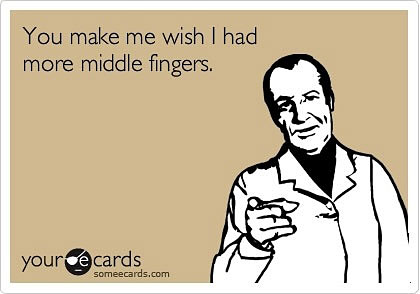
In 1644, John Bulwer compiled a guide to common hand signals for the deaf. The finger, or convicium facio (meaning, I provoke an argument) was a "natural expression of scorn and contempt." 
The first recorded American appearance of the finger was in 1886 when baseball pitcher Charles “Old Hoss” Radbourn of the Boston Beaneaters gave the third finger salute in the team picture.

Hard to see, but there.  
Americans took it as a symbol of rebellion and humor.  We’ve been flipping the bird in portraits ever since.  It's become a ubiquitous part of our lexicon and culture, just ask Holden Caulfield.  Even Vice President Nelson Rockefeller expressed himself to a group of hecklers using his fool’s finger during a campaign rally in 1976.

Nelson Rockefeller shows his ability to embrace youth culture.
Ira Robbins, a law professor from Washington D.C., wrote a law review article called Digitus Impudicus: The Middle Finger and the Law in 2007.  In it he details the historical and legal implications of flipping the finger.  The gesture is generally covered under the principles of free speech.  When contested, there have been no cases (assuming no other criminal behavior) successfully prosecuted about the use of the finger alone representing a criminal act.
In celebration of that truly American form of expression, I give you a few of my favorite birds.
Went up against a Russian MiG with just a finger.

Right turn, Clyde.

Galileo's middle finger is now preserved in an Italian museum after it was removed post mortem by a souvenir seeker.
No one flips the bird like Jean Luc Picard. 

Have a great weekend!  And I wish Bunny Foo-foo to you all.

Wednesday, December 7, 2011

At least I don't sell funnel cakes anymore.

LYRIC O’ THE DAY:
She’s long gone with her red shoes on
Gonna need another loving babe
--Nobody But the Baby, Allison Krauss, Gillian Welch, Emmylou Harris
This Insecure Writer’s Support Group post isn’t exactly about writerly insecurities, but about the decisions we make in order to be secure.  Because lately, most of my insecurities have to do with my Day Job, which isn’t writing.  Writing is my salvation, my dream--the highlight of my reality.  The Day Job is becoming less and less emotionally fulfilling for me.  The reasons I went in to medicine are incongruent with what medicine is becoming.
So I should quit, right?  Find a better fit?  Well here’s where that insecure part of me comes in.  Down deep, I am a practical gypsy.  A gypsy with a mortgage, and school loans, and health insurance costs for two little boys.  A gypsy that knows I am fortunate to have the security of any job in this economic climate.
I dedicate today’s post for the Insecure Writer’s Support Group to being too insecure to give up security.  To embracing the jobs that put money in your pocket while you chase other dreams.  The jobs that you’d change in a heartbeat if the opportunity presented itself.
I have had a variety of craptastic jobs in my life.  I have been employed as the Wal-mart snack bar queen, forced to wear a smock and distribute liquid cheese.  I was a construction strumpet (see Vibrator girl for further info).  I offered my body to medical science as a guinea pig for an experiment on acid reflux.  When someone comes at you with a tube they want to stick down your throat, don’t believe them when they tell you that anesthesia is not necessary.  Unless you’re in to that sort of thing.
I was thumbing through an advertisement the other day when I was triggered to recall one of my favorite sucktacular jobs.  The good folks at Bed, Bath and Beyond have now made it possible to own--for the low price of $14.99--your very own funnel cake maker set.  Because families out there are so desperate for food implements that this will become a crucial part of daily food prep.  And heck, with the obesity crisis looming, why not support a chicken in every pot, a car in every garage, and a funnel cake maker in every pantry? 

Begin flashback to a sultry Nebraska summer in 1988, complete with acid washed cutoffs and explosion bangs as far as the eye can see.  
Setting:  The Dawson County Speedway concession stand.
Occupation:  Funnel cake maker.
For those of you who have no idea what a funnel cake is, think bastardized fritter.  It involves batter.  Not the tight pants and Skoal batter of baseball fame, but pancake batter.  Overly sweetened batter that still has the gritty texture of its powdered mix origins.  Put said batter into a device reminiscent of the Tin Man’s oil can.  Heat a skillet of fluorescent yellow industrial grade vegetable oil until sweat drips off your brow from the radiant heat.  Place a piece of circular metal into the pan--this is your funnel cake “mold”.  Now pour the batter in a frenetic pattern resembling something a schizophrenic spider might make.  This is out of necessity, not design, because quick movements are required to avoid splattering scalding grease on lily white skin.  The scars of the summer of ’88 will be with me forever, literally.  
The batter should puff up and turn golden brown.  If it resembles the last time your cat Mr. Snuggles had the runs, there is a problem with the mix to liquid ratio.  Flip the cake and cook the other side. 
Once both sides are complete, transfer the creation onto a layer of paper towels to soak up extraneous grease.  Or if you work at the Speedway, add a pound of powdered sugar to serve the purpose instead.  Because nothing says delicious like a powdered sugar/oil slurry.  Whipped cream is also your friend and can camouflage breakage and overzealous cooking.  Throw the thing on a styrofoam plate, making sure it’s still hot enough to melt holes in the pseudo-plastic and increase your carbon foot print two-fold.  Serve with a sprig of mint and a smile.  
The funnel cake was a popular item at the Dawson County Speedway.  Something about the sound of roaring engines and the smell of burning rubber makes a person crave oil saturated dough and things that are white and powdery.  Eau de Fryer was the perfume of the concession stand jezebel that attracted rotund Nebraskans from miles around.

Perhaps not the worst fair food, but I'm biased.  My kingdom for a deep fat fried twinkie.
Our motto was:  “Ignore the numbness in your arm.  That’s just saturated fat giving you a hug.”
Every morning when I get up without the stench of fried dough clinging to my hair, I feel thankful for my current job, even if it’s not exactly where I want to be.  

What’s the worst job you’ve ever had to pay the bills?

Sunday, December 4, 2011

A Peace of My Mind: Investigating the Peace Symbol

LYRIC O’ THE DAY:
I am looking for someone who can take as much as I give
Give back as much as I need
And still have the will to live
--Blood and Fire, The Indigo Girls 
December is here and I find myself feeling sort of introspective, trying to look back at the year and decide what direction to head in the new.  I guess I’m searching for inner validation, the big tattoo of a peace sign on my soul.
from teachpeace.com
But would that mean what I thought it did?  Or would I be like those poser chicks (here’s looking at you, Britney) who get Chinese letters inked on, only to realize later they now have a recipe for egg drop soup on their shoulder?
This Sunday’s mythbusters focuses on that ubiquitous circle of hippie code, the peace sign.

Artist Gerald Holtom is credited with designing the peace symbol as we know it for Britain’s pacifist organization against nuclear war, the Direct Action Committee.  It was first publicly displayed in the Aldermaston peace marches of 1958.  Holtom said to Hugh Brock, editor of Peace News, that he was in “deep despair” when he created it and took inspiration from Goya’s depiction of a peasant in front of a firing squad.  
Francisco Goya's Peasant Before the Firing Squad
Finding resistance in using depictions of the cross as part of his design, he decided to use downcast “arms”, taking a cue from semaphore code.  Supposedly, he combined the letters N and D into a unified structure to represent Nuclear Disarmament.  
Later in his life, Holtom expressed regret to Ken Kolsbun in his book “Peace: the Biography of a Symbol” that he did not stick with his original idea of upwardly cast “arms” given the negative connotations with the downcast model.
What negative connotations, you ask?  Some claim the origins of the peace sign were anything but peaceful, most citing its ancient links to paganism.  Indeed, the upright symbol resembles a Norse rune and some refer to it as “the Druid’s foot”.  The rune Algiz, aka the “elk” rune, is a protection rune symbolizing spirituality and the divine might of the universe.  Many anti-peace sign writers claim it is a “rune of death”, but most pagan scholars believe that in the reverse it simply means lack of protection or no connection with inner spirituality. 
The Elk Rune
The peace sign became an anti-Christian symbol in the first century A.D.  The Roman emperor Nero is historically known for his early persecution of Christians.  Some scholars attribute the execution of the Apostle Peter to him as well.  Peter was crucified upside down.  There are two possible reasons why--some literature claims he requested this as a symbol of his unworthiness when compared to Christ.  In the Catholic church, many still view the upside down cross as a symbol of humility.  However, others believed this was Nero’s attempt to denigrate Christianity.  Nero’s cross, aka “the broken Jew,” is still seen by many as a symbol of the “anti-Christ”.  Anton Levey, founder of the Church of Satan, supposedly uses the symbol as a backdrop for his altar.  Black metal and pop culture also encourage the Satanic implications of the symbol as an upside down cross/crucifixion.

The anti-Christianity tag stuck with the sign during the early A.D. centuries.  The Saracens, a group of desert warriors living in ancient Arabia, reportedly used a similar image on their shields. This group has been described originally as pagan or polytheistic, but towards the 1000s became synonymous with Islam (Wikipedia). This “broken cross” symbolized their refusal to accept Christianity. 

The Saracens now battle as a rugby team from St. Albans, England.
German calligrapher Rudolph Koch proposed a different meaning for the symbol.  In his “The Book of Signs” from 1930, the inner “witch’s foot” represents the death of man, while the outside circle is eternal life or the unborn child.  Some scholars argue this is simply a depiction of a pagan circle of life.  However, the Nazi's use of the symbol in their 3rd Panzer Division from 1941-1944 and on the graves of some SS soldiers led some to believe it represented the eternal destruction of mankind.
Rumor says the peace sign made its way to America in 1960 with Philip Altbach, a leading member of the Student Peace Union based at the University of Chicago.  This nationwide student organization expressed pacifist and humanitarian sentiments.  Much of their focus was on anti-nuclear protests and the peace sign eventually made its way across the country.  The ideas of pacifism and anti-war were often interpreted as cowardly--leading some to dub the peace sign "the footprint of the American chicken."  In cold war conspiracy theory, some claim that the Soviets were behind the proliferation of the symbol in an effort to cause political and social clashes.  The theories of Communism were seen by many as anti-Christian, and thus equated with the symbol. 

The desire for peace is far from cowardly.  Vietnam era helmet.  Taken from warrelics.eu

Nowadays you can go into any department store in the U.S. and find articles emblazened with the peace sign, but I doubt most consumers know about its history.  When you see someone wearing a peace sign, I think for most it is an attempt to convey love and hope for a better tomorrow.  At least that’s what it is for me.


Peace to you all.  Don’t forget about Alex J. Cavanaugh’s Insecure Writer’s Support Group coming up Wednesday.


Sunday, November 27, 2011

Somewhere Over the Rainbow

LYRIC O’ THE DAY:
Shut off the beacons, cause we know what's out there
Forever quarrel between the sky and I
--The Sky and I, Scarlet Grey
As a mother, you learn to think on your feet, especially when your kids hit the "question everything" stage.  My son recently asked me how to make a rainbow.  When the fruit of my loins appeared unmoved by my explanation involving water droplets and sunshine, I told him that rainbows were magical conduits to Oz.  

And he was appeased.


In its most basic form, the rainbow is a multicolored arc created when sunlight is refracted then reflected inside droplets of atmospheric moisture.  Not just a rainy day phenomena, rainbows can occur anywhere there is a combo of light and mist:  waterfalls, Elmo sprinklers, and even at night (called a moonbow).

A classic rainbow.
Sprinkler rainbow.
A moonbow.
Rene Descartes is credited with describing the physics of the rainbow in 1637 by using a sphere to represent a single droplet of water.  As sunlight hits each droplet (sphere) of water, angles of refraction occur. Here’s the physics:


Water droplets must be of a certain size for this refraction to occur.  If the microscopic droplets that make up clouds were a little larger, we could have technicolor skies.
Since my grasp of physics is fairly limited, I’m moving on to something I’m a little more comfortable with--fiction.  Almost every culture has folklore tied to the rainbow.  The sight of a rainbow usually represents one of three things:  a connection to the gods, a serpent, or as in Hindu cultures, an archer’s bow belonging to a god.
The first written description of a rainbow occurs in the Epic of Gilgamesh, the story of an ancient Sumerian king from around 3000 B.C.  They were described as both a divine sanction of war and as a symbol of immortality gained from service to the gods.

Norse mythology tells of the Bifrost--a rainbow bridge that connected Asgard, the realm of the gods, with Midgard, the physical earth.
Friedrich Wilhelm Heine's "The Battle of the Doomed Gods".  Bifrost is in the background.
Greek myth utilized the rainbow as a multicolored escalator for the minor messenger goddess Iris, wife of Morpheus.  Unfortunately, the news she brought over the rainbow was often bleak--it was her spilling the beans about Helen's abduction that started the Trojan War.

Pierre Narcisse Guerin's Morpheus and Iris.
In the Judeo-Christian story of Noah, the rainbow represents God’s promise that he would never destroy the world again via flood.  

Several cultures use rainbows to represent the ascension of souls to heaven.  North American Indians have referred to rainbows as “pathways of souls.”   The Japanese call it a “floating bridge of Heaven.”
Ancient Slavs saw the rainbow as something more menacing, bringing death and bad luck.  According to their beliefs, a person touched by a rainbow would become a demon.  Australian aborigines thought rainbows were great serpents sent after rains to claim unsuspecting victims and create mischief.  Since they were connected to water, these serpents represented life and the struggle of man with the often harsh conditions of life in the outback.  
Artist Peter Eglington's rendition of the Australian Rainbow Serpent
A few unique myths exist about rainbows.  Some are familiar, such as the story of the Leprechaun’s pot of gold.  Others are tales about the resilience of the human spirit and the power of love.  In Hawaii, the rainbow was actually the aura of a maiden named Kahalaopuna, reflected as she danced in the skies.  She took two chieftains as lovers, but one, Kauhi, became insanely jealous and killed her.  When her spirit guides tried to rejoin her soul with her body so she could ascend to Heaven, Kauhi retaliated by burying her body beneath the tenacious roots of a koa tree so she could not be reached.  Her other lover, Mahana, found her body and with the help of a kahuna returned her spirit to her.  Only his true love made it possible for the maiden to be whole again.  Together, they tricked the evil Kauhi into admitting his crimes and he was later burned in an oven.  And that totally makes me think of rainbows. 
I must admit, my favorite myth comes from Bulgarian legend, in which walking beneath a rainbow will change your gender.

Steven Tyler gives some plausibility to the Bulgarian myth in his rainbow duds.  Dude Looks Like a Lady, indeed.
The rainbow has made its appearance throughout history as a symbol of political and social upheaval.  As early as the 16th century, a rainbow flag was used by the German Peasants' War to signify hope and change.  Fast forward to the mid twentieth century, when Italy used a rainbow flag as a sign of peace during protests against nuclear weapons.  
Probably the most recognizable modern rainbow flag is used as a symbol of the gay pride movement. Gilbert Baker, a San Francisco artist, designed the original in 1978 with eight stripes:  pink, red, orange, yellow, green, turquoise, blue, and violet.  They represented, respectively, sexuality, life, healing, sun, nature, art, harmony, and spirit.  Turquoise and pink were later removed due to problems with mass manufacturing those colors at the time.

The pride flag as Baker initially created it.
Rainbows continue to be symbols of diversity.  The National Rainbow Coalition was a political organization that grew out of Jesse Jackson’s 1984 presidential campaign.  He appealed to the disadvantaged voter from a broad spectrum of races and creeds.  The Rainbow Coalition merged with Operation PUSH (People United to Save Humanity) in 1996 and still is involved in a variety of social initiatives.
A rainbow initiative I miss a lot.
In gypsy dream lore, rainbows are thought to represent a connection between the earthly self and the higher enlightened self--a symbol of redemption and hope.  Seeing a rainbow is always sort of a spiritual experience for me--it evokes positive vibes and a mental check of my blessings.   But not near as much as it does for this guy.


Sunday, November 20, 2011

Let's Talk Turkey

LYRIC O’ THE DAY:
Beautiful, beautiful girl from the North
You burned my heart with a flickering torch
--Candy, Iggy Pop
My dad’s 70th birthday is next week, but we celebrated this weekend, just so we could have two calorie laden fests in a row instead of one.  As a result, I can finally cross eating at the home of “Nebraska’s Testicle Festival” off of my bucket list.  
After I got over the disappointment of false advertising, I stared at a plate of turkey fries, aka turkey testicles, contemplating the meaning of Thanksgiving.  Not as much of a stretch as it sounds. 
Thanksgiving probably had its ancient roots in religious events thanking the gods for prosperity.  These “thanks givens” were held by nearly every culture several times a year and not always at a particular time.  Texans claim the first American Thanksgiving took place near El Paso in 1598 when Spanish explorer Juan de Onate finally arrived on the banks of the Rio Grande after a 350-mile trek through the Mexican desert.
Turkey, TX may not be able to claim Thanksgiving, but don't mess with the name
According to people not from Texas, the first Thanksgiving took place at Plymouth Colony in October of 1621.  It was attended by 50 colonists and 90 Wampanoag American Indian men (sorry, ladies).  Everything we know about the three-day Plymouth gathering comes from a description in a letter wrote by Edward Winslow, leader of the Plymouth Colony.  Perhaps the first myth about Thanksgiving was that it was a solemn, religious occasion.  Not so, according to Mr. Winslow.  The Plymouth Thanksgiving was an impromptu three day harvest festival that was about drinking corn beer, gambling, and athletic games, including target shooting with muskets.  It was never intended to become a yearly holiday--it was basically a big party because of the abundance that year.  Supposedly, the Wampanoag heard gunshots and thought the colonists were attacking.  They came to battle, only to find a party going on.

Some scholars also rain on the thought that Thanksgiving was all about friendship.  According to the United American Indians of New England (UAINE), the Wampanoag Indians and the colonists had an uneasy relationship--based on allegations that the colonists massacred a Wampanoag settlement and ransacked burial grounds in their first months in America.  Some Wampanoag men, including the infamous Squanto, were actually abducted by the English to be slaves overseas.  Despite this, the Wampanoag still taught the colonists how to survive in those early settlements.  Once released from slavery, Squanto became an assistant and liaison for the pilgrims.  In 1970, several Native American groups declared Thanksgiving a national day of mourning, believing it romanticizes the image of forced assimilation.

Time waxed poetic for Thanksgiving.  Over the years, there were always days of “thanks and giving,” but a new nation clamored for a more official holiday.  Finally,  Abraham Lincoln declared Thanksgiving Day a national holiday in 1863.   It’s thought that he was pressured into doing this by the 30-year barrage of letters received from Sarah Josepha Hale, the author of “Mary had a Little Lamb”.  Ms. Hale was a staunch advocate of Thanksgiving.     
The only other time lamb and turkey get together. 
Thanksgiving has morphed into an elementary school icon, complete with reenactments of Pilgrims and Indians getting together to break bread and eat turkey in the name of friendship.

The visual there is a little skewed, too.  The “Pilgrims” actually never called themselves “pilgrims”, they went by “saints” or “strangers”, depending on their reasons for coming to America in the first place.  Saints wanted religious freedom; strangers wanted financial opportunity.  And please don’t confuse them with Puritans--Puritans were all about religious freedom.  Well, at least their own religious freedom.
Also, pilgrims have never been lauded for fashion edginess, but they were probably falsely painted with the penguin brush.  Black and white garb was reserved for formal religious occasions.  And what about those buckles with stiff hats?  Just a 19th century illustrator’s creation thought to look quaint and old-fashioned--the perfect image for a national holiday.
Hello there, Pilgrim.
Another Thanksgiving myth that may surprise you is the assumption that turkey was on the menu that day in 1621.  In Winslow’s letter, he comments that the Wampanoag Indians brought five deer to the festivities and some of the colonists hunted wild foul.  This certainly could have included wild turkey, but the bird gets no individual shout out.

"Were you invited to that pilgrim thing?  I don't know what to wear."
It’s doubtful that some of the most beloved Thanksgiving day side dishes were on the menu, either.  Sweet potatoes and potatoes were not yet part of the colonists’ diets.  Cranberries take sugar, and sugar was an expensive and rare commodity.  And you can forget the Campbell’s soup green bean casserole, too.  Pumpkin, squash, nuts and Indian corn were the vegetables du jour.  Dessert may have been disappointing as well.  Pie wasn’t an option due to lack of wheat flour for the crust, so most likely they had berry and cornmeal porridge.  If you want to try some authentic Plymouth eats, The Plimoth Plantation has recipes for nasaump, curd fritters and stewed pumpkin.  

Not the Pilgrims' feast.
The historical facts behind Thanksgiving continue to be debated.  For modern Americans, it has become a day of family and food.  I look forward to settling into a turkey coma and breaking the wishbone every year--but even those simple things are based on myth.  According to National Geographic News,  the dose of tryptophan, the substance in turkey that is a mild sleep inducing agent, is not enough to get to the human brain when ingested as part of a massive feast.  Seems an empty stomach is required for tryptophan to work.  The real reason you get so sleepy on Thanksgiving day?  It’s related to the average of 4500 calories most people consume during the festivities.
The wishbone is actually a bird’s clavicle, aka the furcula.  The pilgrims called it a merrythought.  The breaking of a wishbone for good luck can be traced back to the ancient Etruscans who used the process as a method of divination.  Birds were thought to have powers of prediction--after all, the rooster announced the dawn every morning with a crow.  Oracles used a dried out wish bone to predict crop viability and success in the coming harvest.  Then they would display it for the community to share. 
Stroking the wish bone was thought to bring good luck and wishes.

Ahem.
And that brings my dirty wish bone stroking mind back to where I started, which was testicles.  See?  I told you it wasn’t such a stretch.
Happy Thanksgiving!  And for those of you with stronger stomachs, try the turkey fries.