LYRIC O’ THE DAY:
Beautiful, beautiful girl from the North
You burned my heart with a flickering torch
--Candy, Iggy Pop
My dad’s 70th birthday is next week, but we celebrated this weekend, just so we could have two calorie laden fests in a row instead of one. As a result, I can finally cross eating at the home of “Nebraska’s Testicle Festival” off of my bucket list.

After I got over the disappointment of false advertising, I stared at a plate of turkey fries, aka turkey testicles, contemplating the meaning of Thanksgiving. Not as much of a stretch as it sounds.
Thanksgiving probably had its ancient roots in religious events thanking the gods for prosperity. These “thanks givens” were held by nearly every culture several times a year and not always at a particular time. Texans claim the first American Thanksgiving took place near El Paso in 1598 when Spanish explorer Juan de Onate finally arrived on the banks of the Rio Grande after a 350-mile trek through the Mexican desert.
 |
| Turkey, TX may not be able to claim Thanksgiving, but don't mess with the name |
According to people not from Texas, the first Thanksgiving took place at Plymouth Colony in October of 1621. It was attended by 50 colonists and 90 Wampanoag American Indian men (sorry, ladies). Everything we know about the three-day Plymouth gathering comes from a description in a letter wrote by Edward Winslow, leader of the Plymouth Colony. Perhaps the first myth about Thanksgiving was that it was a solemn, religious occasion. Not so, according to Mr. Winslow. The Plymouth Thanksgiving was an impromptu three day harvest festival that was about drinking corn beer, gambling, and athletic games, including target shooting with muskets. It was never intended to become a yearly holiday--it was basically a big party because of the abundance that year. Supposedly, the Wampanoag heard gunshots and thought the colonists were attacking. They came to battle, only to find a party going on.

Some scholars also rain on the thought that Thanksgiving was all about friendship. According to the United American Indians of New England (UAINE), the Wampanoag Indians and the colonists had an uneasy relationship--based on allegations that the colonists massacred a Wampanoag settlement and ransacked burial grounds in their first months in America. Some Wampanoag men, including the infamous Squanto, were actually abducted by the English to be slaves overseas. Despite this, the Wampanoag still taught the colonists how to survive in those early settlements. Once released from slavery, Squanto became an assistant and liaison for the pilgrims. In 1970, several Native American groups declared Thanksgiving a national day of mourning, believing it romanticizes the image of forced assimilation.

Time waxed poetic for Thanksgiving. Over the years, there were always days of “thanks and giving,” but a new nation clamored for a more official holiday. Finally, Abraham Lincoln declared Thanksgiving Day a national holiday in 1863. It’s thought that he was pressured into doing this by the 30-year barrage of letters received from Sarah Josepha Hale, the author of “Mary had a Little Lamb”. Ms. Hale was a staunch advocate of Thanksgiving.
 |
| The only other time lamb and turkey get together. |
Thanksgiving has morphed into an elementary school icon, complete with reenactments of Pilgrims and Indians getting together to break bread and eat turkey in the name of friendship.

The visual there is a little skewed, too. The “Pilgrims” actually never called themselves “pilgrims”, they went by “saints” or “strangers”, depending on their reasons for coming to America in the first place. Saints wanted religious freedom; strangers wanted financial opportunity. And please don’t confuse them with Puritans--Puritans were all about religious freedom. Well, at least their own religious freedom.
Also, pilgrims have never been lauded for fashion edginess, but they were probably falsely painted with the penguin brush. Black and white garb was reserved for formal religious occasions. And what about those buckles with stiff hats? Just a 19th century illustrator’s creation thought to look quaint and old-fashioned--the perfect image for a national holiday.
 |
| Hello there, Pilgrim. |
Another Thanksgiving myth that may surprise you is the assumption that turkey was on the menu that day in 1621. In Winslow’s letter, he comments that the Wampanoag Indians brought five deer to the festivities and some of the colonists hunted wild foul. This certainly could have included wild turkey, but the bird gets no individual shout out.
 |
| "Were you invited to that pilgrim thing? I don't know what to wear." |
It’s doubtful that some of the most beloved Thanksgiving day side dishes were on the menu, either. Sweet potatoes and potatoes were not yet part of the colonists’ diets. Cranberries take sugar, and sugar was an expensive and rare commodity. And you can forget the Campbell’s soup green bean casserole, too. Pumpkin, squash, nuts and Indian corn were the vegetables du jour. Dessert may have been disappointing as well. Pie wasn’t an option due to lack of wheat flour for the crust, so most likely they had berry and cornmeal porridge. If you want to try some authentic Plymouth eats, The Plimoth Plantation has recipes for nasaump, curd fritters and stewed pumpkin.
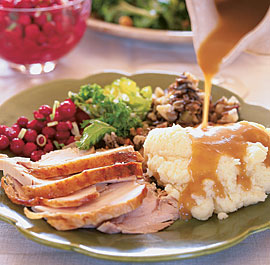 |
| Not the Pilgrims' feast. |
The historical facts behind Thanksgiving continue to be debated. For modern Americans, it has become a day of family and food. I look forward to settling into a turkey coma and breaking the wishbone every year--but even those simple things are based on myth. According to National Geographic News, the dose of tryptophan, the substance in turkey that is a mild sleep inducing agent, is not enough to get to the human brain when ingested as part of a massive feast. Seems an empty stomach is required for tryptophan to work. The real reason you get so sleepy on Thanksgiving day? It’s related to the average of 4500 calories most people consume during the festivities.
The wishbone is actually a bird’s clavicle, aka the furcula. The pilgrims called it a merrythought. The breaking of a wishbone for good luck can be traced back to the ancient Etruscans who used the process as a method of divination. Birds were thought to have powers of prediction--after all, the rooster announced the dawn every morning with a crow. Oracles used a dried out wish bone to predict crop viability and success in the coming harvest. Then they would display it for the community to share.
Stroking the wish bone was thought to bring good luck and wishes.
 |
Ahem.
And that brings my dirty wish bone stroking mind back to where I started, which was testicles. See? I told you it wasn’t such a stretch.
Happy Thanksgiving! And for those of you with stronger stomachs, try the turkey fries.
