Showing posts with label mythbusting. Show all posts

Sunday, September 18, 2011

Mermaids: A fishy tale.


LYRIC O' THE DAY:
We’re covered by the sacred fire
When you cut me, you cut me to the bone
--Lorelei, The Cocteau Twins

I have to thank a completely random conversation with Lydia Kang about the movie Mermaids and feeding children with appetizers for today's inspiration on Sunday Mythbusters.  


Thanks to the power of Disney, most people picture a perky redhead when they think of mermaids.

However, these mythical creatures of the sea were around way before the advent of cartoon sexuality thinly veiled as family-friendly cinema.  In contrast to Ariel’s innocent ingenue, mermaids were seldom considered a good omen--in fact, sightings often meant bad weather or worse.  Sailors enchanted by mermaid's songs followed them to a watery death, drowned by a vixen turned vicious.  And what of those who did find love with a mermaid?
“A mermaid found a swimming lad,
Picked him for her own.
Pressed her body to his body.
Laughed and plunging down
Forgot in cruel happiness
That even lovers drown.”
--W.B. Yeats
Mermaids traditionally have been seen as half man, half fish.  However, merfolk encompass all creatures from the sea that shapeshift to human form.  Nearly every culture has a type of mermaid:  selkies, melusines, roanes, rusalkas, undines, loreleis and nixies to name a few.
The first mermaids represented sea gods.  The Babylonians worshipped a sea god named Ea--the earliest version of Neptune.  Atargatis was a Syrian goddess who banished herself to the sea because she was so distraught over getting knocked up by her mortal lover.
No word on how he took it.
Atargatis eventually adapted to pregnancy and became known as Derketo to the Greeks (and to Robert E. Howard’s Conan).  In Greek myth she is sometimes confused with Aphrodite.  Even today there are mermaid deities.  In Africa, a fertility goddess named Mami Wata heals the sick but will drown those who dare disobey her.  In the Caribbean and Haiti, La Siren is worshipped in the Vodou religion.  And in America, we have Cher.

Not all mermaid legends came from such lofty ancestors.  The Roman poet Ovid claimed mermaids formed from the burning wood of Trojan ships during the Trojan war.  Indeed, mermaids are mentioned by Homer in the Odyssey as attempting to lure Ulysses away from his ship as he sailed home from Troy.  Irish mermaids are reported to be the souls of old pagan women banished from the land by St. Patrick.  In China, mermaids are believed to be simple-minded water nymphs who bring happiness or sadness based on the color--and smell--of their tails.  Apparently a purple tail smells like happiness.  Red tail smells like sorrow.  Don’t ask what the brown tail smells like.  
Slavic myths (always my favorite) tell the story of the rusalka, a mermaid demon who lives in lakes and waterways.  Generally the rusalka is a woman who has died a violent death before her time, often from suicide or at the hands of a lover.  During Rusalka days in June, they come out of the water and take to the trees to try to woo men to their deaths with song.  Antonin Dvorak wrote his opera, Rusalka, based on this folktale. 
The Rusalka by illustrator Ivan Bilibin
There have been numerous mermaid sightings throughout history.  Columbus in 1493 saw three mermaids in the area of the Dominican Republic.  According to his journal, he was quite dismayed that they weren’t at all beautiful--in fact, they looked manly in the face.  Most scholars now believe he saw a group of manatees.  In his memoirs, John Smith claimed to see mermaids by Massachusetts, although he also claimed to see blue men with square heads, Pocahontas, and cannibalistic women warriors who wanted him for sexual slavery.  Henry Hudson in 1608 sighted a mermaid with 2 other crew members.  They described it as half porpoise and half woman, skin spotted like a mackerel, and with large, "magnificent" breasts.  Which just goes to show you men love T&A, no matter what the species.  And if you need a more recent sighting, in 1998 in Kona, Hawaii, a team of divers following a school of dolphins photographed a real mermaid--the Weekly World News said so.  And on the next page they had a story about Hilary Clinton’s alien baby.
Photo of a "real" mermaid in Hawaii
Perhaps those divers were actually vacationing at a Florida resort called Weeki Wachee, the City of the Mermaids.  In 1946, a former Navy Seal trainer got the idea to teach attractive young women to free dive using an air hose.  He took his plan one step further, and had them wear elaborate mermaid costumes.  Thanks to capitalism and post WWII sexual curiosity, Weeki Wachee became an aquarian Vegas and is still in existence.
Get your 2011 calendar on the website!
With so many mermaid sightings, one would think a corporal mermaid would be discovered and studied.  The anatomy of the mermaid was first described around the fifth century A. D. in a text called the Physiologus, which was basically a listing of beasties of the day--like a medieval Encyclopedia Britannica.  There are a few descriptions of “mermaid autopsies,” but none have been verified.
P.T. Barnum is credited with bringing the mermaid to the masses in the 19th century with his sideshow exhibit called “The Feejee (Fiji) mermaid.”  However, he likely got the idea--or even the exhibit itself--from the son of an English captain who traded his ship and its contents for what was eventually revealed to be a monkey’s torso sewn to the body of a fish.  Versions of the Feejee mermaid have been seen even in Renaissance times, well before P.T. Barnum saw an opportunity to profit in the era of Darwinism during the 1860s.  Unfortunately for Barnum, this oddity was not at all popular in America--and even caused riots when folks expected a half naked Daryl Hannah and got a wrinkled piece of taxidermy.  On a tangential note, a Feejee mermaid was a murder suspect in an X-files episode.  The killings eventually were found to be done by a parasitic twin.  I really miss the X-files. 
What we were hoping the Fiji mermaid would look like.
What the Fiji mermaid did look like.

The most recent merfolk hoaxes occurred after the devastation of the December 2004 Indian Ocean tsunami.  The following video depicts a "real" mermaid that washed up on a shore after the storm.

Some mermaid myth is likely based on a congenital defect that occurs in 1 of approximately 90,000 births known as sirenomelia, in which an infant is born with its legs fused together.  Generally, this is a fatal malformation due to kidney and urinary tract abnormalities.  Currently there are only two people in the world known to be living with sirenomelia according to Wikipedia.  A Peruvian child named Milagros Cerron received worldwide attention when she underwent a series of operations to separate her legs in 2005.
Milagros at the beginning of her surgeries.

Milagros in 2010.  Pics from odditycentral.com.
Most scholars now attribute the historical sightings of mermaids to the the animal group Sirenia, which includes manatees, dugongs, and the extinct Steller's sea cow.  However, the sounds that a manatee makes are generally high pitched squeaks, whistles and clicking noises, not easy to be confused with the haunting and beautiful melodies associated with mermaids.  We may never know what sailors were really seeing on those lonely nights at sea.
Give us a kiss!
Mermaids will always hold a soft spot in my heart--I'm an Aquarius after all.  The idea of a creature crawling on the shore to form legs and walk may be more fact than fiction depending on your beliefs.
There are some amazing paranormal novels dealing with merfolk--they are enjoying "new shiny thing" status in fiction currently.  It seems fitting that one of the most popular icons of the 21st century represents the sailor’s muse--and perhaps the writer’s as well.


Sunday, September 4, 2011

The Tooth Fairy: Mouse or Menace

LYRIC O’ THE DAY:
And the devil in the black dress watches over
My guardian angel walks away
Life is short and love is always over in the morning
Black wind come carry me far away
--Temple of Love, The Sisters of Mercy

Good morning!  I have been loving Rachel Harrie's Writer's Campaign.  I'm steadily visiting lots of new blogs and meeting so many talented folks.  If you've stopped by and I haven't followed you back, please let me know!  Now, on to Sunday's mythbusting.
Armed with a backpack that made him look like a giant turtle, my son reigned victorious over his first week of kindergarten.  He also returned with a valuable bit of information, thanks to a loose tooth and kindergarten lore.
“Mommy, the tooth fairy is going to bring me a lot of money for my tooth when it falls out.”

My boy looked a lot like this during his declaration.

Ah, the currency of calcium.  A child has 20 deciduous or “baby teeth” to lose between the ages of 6 and 12.  For most cultures, it’s a simple rite of passage.  To lessen the blow of leaving childhood, the idea of a benevolent spirit purchasing a freshly extracted tooth has become well accepted.  But before I started this post, I had no idea where this myth came from.  To my surprise, there was no dentist to blame.
Teeth have long been symbols of power, luck, and protection.  Teething rituals date back to ancient times with the earliest mentions of the tradition in the Prose Edda and Poetic Edda, the most extensive written account of Norse poetry and mythology.  Viking folk were quite wary of witchcraft and demons, and believed that teeth offered a pearly protection.  If a child lost a tooth, their warrior parent would give them a “tooth fee” for it.  The Vikings often wore them as jewelry; a toothy talisman against demons.  This tradition is still practiced today by warriors of the celebrity sect, as shown by my favorite Rocky Horror sweetheart, Susan Sarandon.  Here she wears a bracelet made from her daughter's baby teeth.

I actually think this is kinda cool.  Photo from hollybaby.com

Native Americans often used teeth in their medicine bags, believing them to have powers in love and protection magic.  Gypsy lore suggests that parts of another human--like nail clippings, hair, or teeth--can be used in sympathetic magic.  This is similar to how voodoo dolls are used.  For that reason, they would destroy lost teeth in a fire, or in some cases, have an adult swallow them.  Yum!
I suspect that’s something Paula Deen will NOT be covering in butter anytime soon.
Some cultures buried lost teeth to help the child “grow a new one.”  In Asia and Africa, teeth were thrown on the roof for scavenger animals to retrieve.  Supposedly if a mouse or rat ate the tooth, that would ensure future sharp teeth for the child. 
Speaking of the order Rodentia, the Europeans seemed quite taken with tales of mice with tooth fetishes.  In Scotland, a white rat purchased lost teeth.  In Spain, “Ratoncito Perez," aka Perez the little mouse, promised money for each lost tooth.  Italy, Germany, and the Czechs all had their own version of the tooth mouse.  Not to be outdone, the Finnish went so far as to create a “tooth troll,” a vile creature named Hammaspiekko that would drill holes in children's teeth if they ate too much candy.  

Now that’s something you don’t read in a Dr. Spock baby book.  Although this clip from Metalocalypse is enough to make me stop eating candy.  And serves as a reminder to let my kid know that teeth only grow back once.
At some point, the tooth mouse morphed into a fairy, and an 18th century story called La Bonne Petite Souris (The Good Little Mouse) may be the reason.  In this tale, a beautiful fairy disguised as a mouse saves a princess from an evil king by repeatedly biting him in the face, ultimately causing his death.  It’s probably much more poetic in French.  
The diabolical tooth mouse.
America helped the tooth fairy finally wax her whiskers and became a proper lady.  A three act play titled “The Tooth Fairy” came out in 1927, but the first published children’s story on the subject as we know it is believed to be by Lee Rogow in 1949.  Some folklorists think that once Rogow’s story established the legend, the media, post-war affluence, and a more child-centered mindset in American families allowed the Tooth Fairy to take her place with Santa, The Easter Bunny and The Great Pumpkin.  

What pre teen boys hope the tooth fairy looks like.  Drawing by 14-bis on deviantArt from google

What the tooth fairy actually looks like.  Drawing by wolfgangmustdie on deviantArt from google
Rosemary Wells, a professor at Northwestern University Dental School, was a leading tooth fairy authority.  She had an extensive collection of tooth memorabilia showcased in The Tooth Fairy Museum in Deerfield, Illinois (now defunct).  Her research showed that the idea of a tooth fairy and treats in exchange for teeth was universally shared in most cultures as a way to soothe the transition from child to adult.  Simply, it was a way to get children to look forward to something normally unsettling.
  
The Tooth Fairy still shows up in popular media.  Take 2010‘s creatively named cinematic zenith, “The Tooth Fairy,” starring Dwayne “The Rock” Johnson.  Didn’t see it?   I guess mouse to fairy to WWE warlord was a folkloric jump people were not willing to make.  Give it another 100 years. 


In literature, Terry Pratchett’s Discworld series has a story line of tooth fairies who possibly originated from the bogeyman.  His fairies always carry pliers in case they can’t make change and need to extract an extra tooth to make it all even.  For horror lovers, Thomas Harris’s novel Red Dragon follows a cannibalistic serial killer nicknamed, “The Tooth Fairy.”
Tasty Teeth, a Hellboy story from Guillermo del Toro, tells how tribes of fairies would suck the marrow from children’s bones.  In 1226 Pope Honorius made a pact with the King of the Fairies to end the carnage--the fairies got children’s teeth in exchange for a silver coin.  According to the story, children stopped believing in the fairies, so they started their grisly marrow suckage again.  Grenades and explosions followed soon after.  Gotta love Hellboy.
The Tooth Fairy is a myth that most people can easily give up.  But my six year-old?


Anyone got a set of fairy wings I can borrow?


Sunday, August 28, 2011

Ouija--child's game or devil's playground?

LYRIC O’ THE DAY:
Heavenly wine and roses
Seem to whisper to me, when you smile
--Sweet Jane, The Velvet Underground
It was a dark and stormy night. 
Ok, not really, but I like to embellish.  I was in seventh grade, one of the fortunate few who was invited to Stacy Smith’s** birthday party.  It was a night of many firsts for me and my burgeoning adolescence.  I experienced my first kiss, a Lady and the Tramp moment thanks to Truth or Dare, the class boy slut, and the vegetable plate Stacy’s mom provided as party food.  As an unfortunate result, “celery” was my nickname well into junior high.  

**names have been changed to protect the innocent
However, the most eventful part of the night was not Frenching with Veggies 101, but playing with a Ouija board for the very first time.  I still remember that musty smell as it slipped out of the cardboard box--like a crypt had been broken open.  Some of the girls were scared to even touch the thing; the guys were fighting over who got to ask it when they would get laid for the first time.  I don’t remember what else we asked it; I’m assuming maybe deep existential questions like why was New Coke necessary or other stuff that was important in 1985.  But before we could get into the nitty gritty of our futures, Stacy freaked out, too panicked to continue.  Mr. Ouija is probably still locked in the hallway closet of the Smith home, waiting to be the gateway board game into harder things, like Dungeons and Dragons.


Although there are some accounts of spirit boards being used as early at 600 B.C.,  the Ouija board in America found its beginnings during the modern Spiritualism movement in the mid-1800s.  Spiritualism, quite simply, is the belief that the living can communicate with the dead.  During its heyday, seances to contact the deceased became a form of entertainment and many mediums enjoyed celebrity status.  Two of the most famous mediums were the Fox sisters from Hydesville, New York.  They devised a method of “rapping” in which they would question the dead and the spirit would answer via a code of knocks and pops.  Later, one of the sisters admitted that the entire thing was a hoax--the sounds were the controlled popping of their toe joints.
MOM TOLD ME NOT TO POP MY TOES!
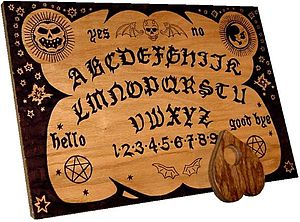
During this time, a French spiritualist named Planchette invented a device that looked like a heart shaped table with a hole for a pencil.  He quite cleverly called it . . . a planchette.  By placing his fingertips on the little table, he used it to channel the spiritual connection into written word--a sort of aided automatic writing.  He then collaborated with a friend who was a coffin maker to develop a wooden board preprinted with letters, numbers and yes/no to make the channeling even simpler, even for a novice.   They sold this idea to an attorney named Elijah Bond and his associate, Charles Kennard, who then patented “the talking board” as a parlor game in 1890.
The “talking board” got its official name from Kennard, who claimed the board named itself during a seance.  “Ouija” was supposedly an ancient Egyptian word for “good luck.”  According to Egyptian scholars, that’s not the case, but it made no difference as sales of the board flourished at $1 a pop.  By 1892, Kennard had been ousted from the company.  William Fuld took over marketing, reinventing the story of Ouija, claiming the name was a combo of Oui and Ja, the French and German words for “yes”.
SEARS AD FOR OUIJA BOARD


After years of battling patent infringements, Fuld fell to his death in 1927 when a support beam he was leaning against gave way while working on a flagpole at the company.  His death only added to the forbidden aura of the Ouija board, which had gained popularity as a true divination tool for occultists.  His family sold the board in 1966 to Parker Brothers, who continue to market it as a game for ages 10 and up.

CURRENT OUIJA GAME FROM PARKER BROS.

The first Ouija boards were made of coffin wood, and the planchette used a coffin nail as a pointer.  In 2010 a hot pink version and a glow-in-the-dark version were sold at Toys ‘R’ Us, much to the chagrin of those who see the Ouija as a tool of the Devil.  Ouija opponents cite scripture in which God condemns those who commune with the dead.  Old Testament Law supposedly supports the execution of anyone who is a medium or channeler, which spells bad news for Jennifer Love Hewitt.  In 2005, Christ Community Church in New Mexico burned Harry Potter books with Ouija boards as “symbols of the occult”.  Certainly there have been instances where people have cited spirits from the Ouija board telling them to kill or harm others.  These claims are difficult to substantiate, given those involved are often considered clinically insane at baseline.
Even in seventh grade, I remember making everyone around the Ouija table pinky swear they wouldn’t purposely move the pointer.  And that first time the planchette moved “by itself”, I certainly thought the spirits were with us.  So what really fuels the mystique of the Ouija?

I'M IN YOUR OUIJA BOARD.

For some, that’s an easy answer--the messages are from beyond the grave, spelled out by a spirit drawn to a piece of mass-production cardboard.
But if you are of the skeptical ilk, the automatism theory is for you.  It relies on a concept described by William Carpenter in 1892 called ideomotor action.  This theory states that unconscious motor behavior is the basis for the seemingly involuntary movements of popular divination materials, i.e. dowsing rods, pendulums, and of course, the Ouija board.  Carpenter believed that muscular movement could be initiated subconsciously--thus the user of the board is responsible for the board movements but is not aware of it.  He cited as examples of other ideomotor based actions:  automatic painting, automatic writing, and sleepwalking.  Proponents of this theory believe that when the Ouija user concentrates, they enter a mild state of hypnosis, opening a conduit into the subconscious.  This is the basis of modern day hypnotherapy.
The area of psychic phenomena was examined in the laboratory setting at Duke University by an American scientist named J.B. Rhine.  He later established The Journal of Parapsychology, which still is in print.  Rhine’s research refuted the idea that demons produced the movements associated with popular tools of the occult.  He popularized concepts like the ideomotor effect, facilitated communication, and self delusion to explain the seemingly unexplainable.  Rhine’s wife, Louisa, in the newsletter of the American Society of Psychical Research said this:
“In several ways the very nature of automatic writing and the Ouija board makes them particularly open to misunderstanding. For one thing, because [such communications] are unconscious, the person does not get the feeling of his own involvement. Instead, it seems to him that some personality outside of himself is responsible. In addition, and possibly because of this, the material is usually cast in a form as if originating from another intelligence.”
In the late 60s and early 70s, many self proclaimed Ouija channelers were discredited with simple blindfolds and letter rearrangement during psychic testing.  But despite those who call the board simply a romanticized tool of hoaxery (Penn and Teller have a fairly colorful offering on their video Bulls**t), you’re not alone if you still believe in the mystical power of Ouija.  Writers seem to have a certain affection for the less tangible explanation--the most famous being Arthur Conan Doyle who supported the belief of Spiritualism.  Pearl Curran channeled a spirit she called Patience Worth through the Ouija for twenty years.  Their collaboration led to several poems, novels and short stories in the early 1900s.  Pulitzer Prize winning poet James Merrill wrote The Changing Light at Sandover, an epic narrative of his communications with angels and spirits via the Ouija board.

AUTHOR'S OUIJA
Cinema also highlights the less Candyland side of Ouija.  The Exorcist is loosely based on the story of a boy in Maryland who experienced unusual symptoms (i.e. possession by evil spirits) after playing with a Ouija board in an attempt to contact his dead aunt.  In the movie, Regan refers to the spirit she contacted via the Ouija board as Captain Howdy--aka Pazuzu the demon of pestilence.  One of my favorite Robin Williams’ flicks, Awakenings, starts with the discovery that Robert de Niro’s character is thinking on a subconscious level and can communicate via a game of Ouija.  And last, but certainly not least if you love cheesy horror flicks was Witchboard, in which a young woman becomes obsessed with talking to a malevolent spirit via her Ouija board.  Not long on plot, but all the dudes in my high school gave it a thumbs up for showing Tawny Kitaen (of Whitesnake hood ornament fame) naked.

The Ouija board has a checkered past, but whether you believe it is just a parlor trick of self-deception or truly a portal to the spirit world depends a lot on your own beliefs about the afterlife.  But just in case you are considering a trip to Toys ‘R’ Us later, keep in mind some of the rules of Ouija:
  1.  Don’t play alone or if you are ill--you’re spiritually susceptible to possession
  2.  Don’t play in places where death has occurred or risk possession (i.e. no graveyards)
  3.  Do not let the board go thru the whole alphabet or numbers in order--it’s an attempt for the spirits to escape
  4.  If the planchette goes to all four corners or in a figure 8, you are in the presence of an evil spirit.  If you want to   prevent this from happening, place a silver coin on the board to stop the evil spirits from coming through
  5.  In order to destroy the board, one must break the board into 7 pieces and sprinkle with holy water, then bury it
HAPPY CHANNELING!

Sunday, August 21, 2011

Who you callin' Goat Sucker?


LYRIC O' THE DAY:
I tried to keep her on a short leash
I tried to calm her down
I tried to ram her into the ground
--Seether, Veruca Salt

First order of business is to thank the lovely Laila Knight for this:
I’m thrilled to know that my ramblings amuse at least one other person than just me.  I stumbled upon Laila's blog one day and have been held spellbound ever since.  And she's a Nebraska girl, which means we are both Children of the Corn.  I hope to someday drink lots of Guinness with her and search for fairy mounds.
Speaking of Guinness, the other night I heard something hurling itself against our patio door.  At first I thought it was just our half-blind Siamese getting her grub on--the cat has a tendency to really enjoy her food.  My next thought was that it was a Chupacabra, so I grabbed the first thing I believed to be a weapon.  I stumbled to the window to see a ball of fur that was much larger than my familiar ball of fur.  But before I could dial the National Enquirer, I flipped on the porch light in time to see five pairs of masked eyes staring back at me.  They were playing street hockey with a bag of IAMS cat food using several stripped stalks of corn from our garden.  I tried to scare them away, but apparently me in a tank top and boxers shaking an Elmo slipper is just not that scary.  I think I heard them laughing as they lumbered across the yard into the night.
Damn raccoons.
Our corn is ruined, but I must thank Rocky and his buddies for my inspiration for this Sunday’s mythbusters:  let’s welcome El Chupacabra.
The Chupacabra is mostly a contemporary legend with the majority of reports of its existence beginning in the mid 90s in Puerto Rico.  However, there have been stories of creatures exsanguinating livestock since Coronado’s time.  The modern Chupacabra is felt to be a folkloric descendant of The Moca Vampire, a creature blamed for the gruesome deaths of farm animals in Moca, Puerto Rico in 1975 shortly after a UFO was sighted in the area.  

Coincidence?  I think not.  

The killed animals reportedly exhibited puncture wounds and were drained of their blood.  Apparently the beast had a taste for goat, so many locals referred to it as a “goat sucker.”  Which is far more poetic in the native tongue as “Chupacabra.”  Sightings died down until 1995 when farm animals again were showing up deathly anemic in Canovanas, Puerto Rico.  An eyewitness described seeing a creature so frightening that the mayor of the city led a hunting party in search of it--complete with crucifixes, rifles and a caged goat.  He did not find the creature, but he did get re-elected. 
The first American sighting was in Florida in 1995 when 27 chickens and 2 goats turned up dead near Miami, mutilated and drained of blood.  Chupacabra attacks have since been recorded from Hawaii to NYC to Russia.  In recent years, the Chupacabra has rocketed into Kardashian-esque popularity in terms of paranormal interest.  It even has its own Facebook page.
What is the draw of a creature that rarely attacks a human, but is notorious for killing livestock by draining their blood like a Homo sapiens-sympathizing sparkling vampire?  Perhaps it’s the visual:

Who you callin' goat sucker?
Although there have been many descriptions of the Chupacabra, most say it is a creature about 3 to 4 feet tall with black or red eyes, fangs, pointed ears, a wolfish face, spikes or fins on its back, and if you get close enough, the pleasant aroma of sulfur.  Actually, that sounds a lot like my college advisor.  I will never forgive him; I was supposed to be a theater major, dammit.
In some Central American myth, El Chupacabra can also have bat-like wings and blends into its surroundings by changing color just like a chameleon.  It moves by leaping on powerful hind legs or flying, and often emits a hissing noise when disturbed.  Whoever hears it experiences waves of nausea and pain, and possibly amnesia.  This is what I think it might sound like.  After looking through so many pictures, it’s hard not to think that the Chupacabra may have a relative on the cryptozoological tree, the gargoyle.  Certainly, some eyewitnesses describe the creature as gargoyle-esque.
There are many speculations on the origin of the Chupacabra. One theory is that the creature is the abandoned pet of some extra-terrestrial life form that came to Earth eons ago.  Which means that at some point, the Earth became the Humane society drop-off for irresponsible alien pet owners.  I present as evidence of this theory: 
If Stitch is a Chupacabra I totally want one.

If you like conspiracy theory, there’s the assertion that Chupacabra is a NASA gene manipulation experiment gone bad.  The most vocal supporter of this argument is Jorge Martin, a self proclaimed UFO researcher and Puerto Rican journalist.  Martin claims that a Chinese-Russian scientist named Dr. Tsian Kanchen has done multiple experiments splicing the genetic code of different creatures, creating what he calls Anomalous Biological Entities, or A.B.E's.  Martin--although without corroboration by Dr. Kanchen--has asserted that the Chupacabra is the result of one of these experiments, which should not be confused with R.O.U.S.'s of The Princess Bride notoriety.
Artist's depiction of a Chupacabra from blueroadrunner.com
Rodent of Unusual Size.  Uh, wait a minute. . .something looks familiar.
There are also those concrete thinkers out there who believe El Chupacabra is nothing more than a wild dog or other animal getting an easy meal via livestock.  So far, they may be right.  In 2009, a taxidermist in Blanco, Texas, thought he had a chupacabra--turned out it was a type of hairless dog native to Mexico and Central America called a Xoloitzcuintle.  Also known as a Xolo, this breed is over 3000 years old and was revered by the ancient Aztecs as a sacred animal, charged with leading its owner through the underworld when the time came.  They also raised it for its meat, which tells me that sacred to the Aztecs might not have been all it was cracked up to be.
Please don't eat me!
When carcasses of creatures believed to be Chupacabras have been found and studied, none have revealed a new species.  Most are identified as coyotes or raccoons with mange.  Other unusual creatures that have been accused of being Chupacabras include an albino civet cat with a skin disease and in one case, an ocean skate.  The most recent sighting of a Chupacabra (outside a Maryland hospital) actually ended with the animal being lured into a trap and videotaped.  “Prince Chupa” was described as a kangaroo-rat-dog mix, but was ultimately identified by Maryland Department of Natural Resources as a fox with mange.  Apparently this was the same week that the hospital instituted a smoke-free policy.  Nicotine withdrawal can be a bitch.

Benjamin Radford, a paranormal investigator and deputy editor of the science magazine Skeptical Inquirer, believes he has debunked the myth of the Chupacabra in his book, "Tracking the Chupacabra, The Vampire Beast in Fact, Fiction and Folklore".  After extensive study of the all of the sightings and stories (including a personal trek in a Nicaraguan jungle to find the critter), Radford traced the physical description of the monster back to Canovanas, Puerto Rico to the original eyewitness account by Madelyne Tolentino.  After talking with her, Radford thought Ms. Tolentino described a creature that was eerily similar to the 1995 human/alien hybrid in Species.  Turns out, she had seen the movie only weeks prior to her run-in with El Chupacabra.  
This is Ms. Tolentino's original description of the creature, thanks to skepdic.com.

And this is Sil from Species.
Could the Chupacabra just be the subliminal creation of one woman’s mind and spread throughout the world by those who want to believe?  Ms. Tolentino was convinced she saw something that day in 1995, but the beast may have been from Hollywood, not from places unknown.